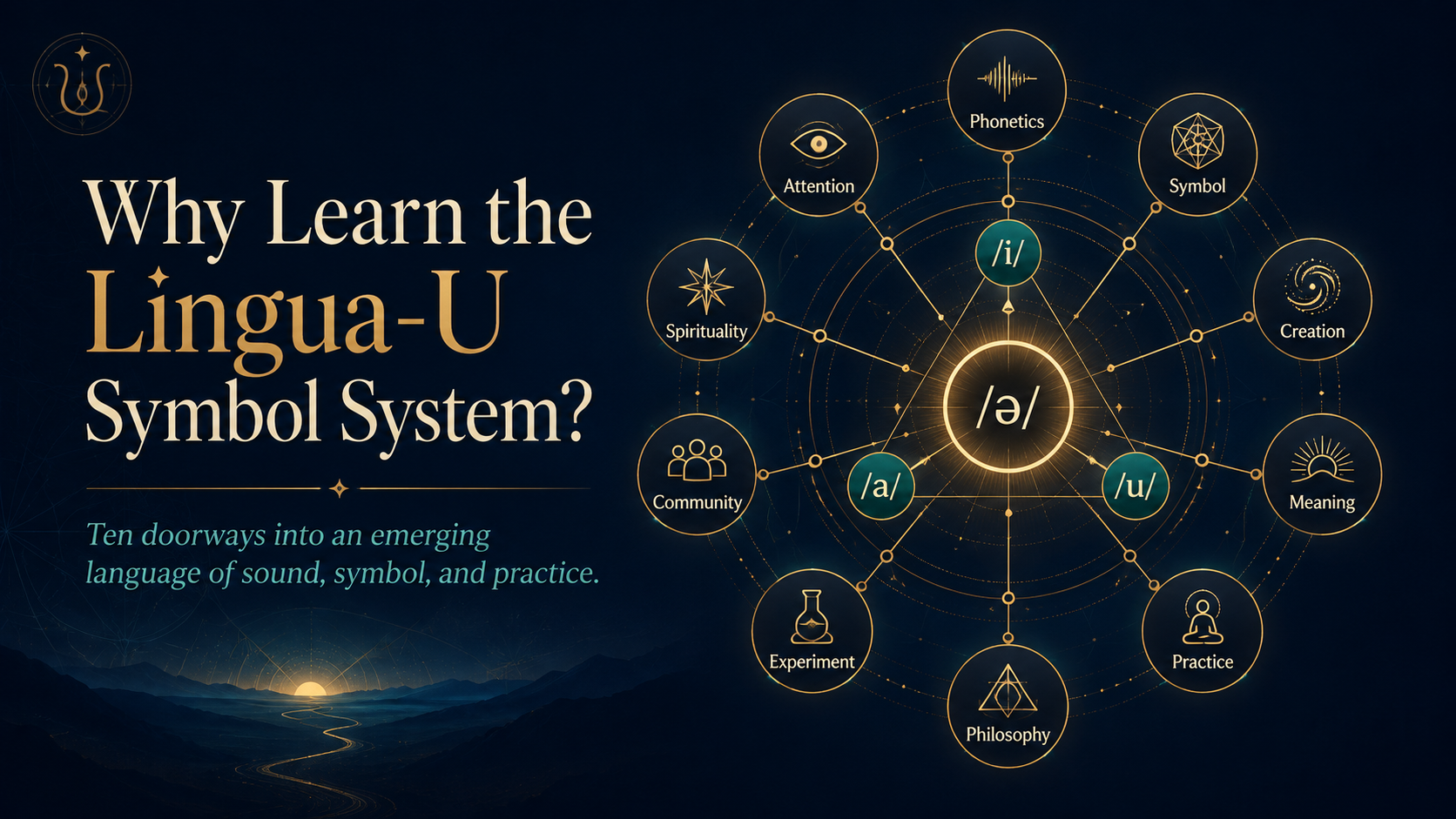
Lingua-U is still young.
It is not yet a full-fledged constructed language. It does not have the vocabulary and grammar of Esperanto, Lojban, or Klingon. It is not a mature philosophical system, and it certainly does not arrive with the centuries of practice, commentary, and community that surround established spiritual traditions.
What Lingua-U does offer is something more provisional: an emerging symbolic technology built around speech sounds, ternary notation, contemplative attention, and the possibility that sound can become a deliberate carrier of meaning.
Why spend time learning a system that is still being built?
1. You will learn phonetics without meaning to
The addresses aren’t arbitrary labels. They’re compressed descriptions. /p/ is 0100 and /b/ is 0101, and once you know that the last digit is the laryngeal position, you know that the only difference between those two sounds is when your voice starts. Put a finger on your throat and say pah, then bah. You’ll feel it.
Most literate adults have never noticed this. We know the alphabet so thoroughly that we’ve stopped hearing underneath it — we think /p/ and /b/ are different letters rather than the same gesture with different timing. Learning the address system is a back door into articulatory phonetics, and you come out the other side knowing things about your own mouth that you’ve been doing unconsciously since you were two.
2. It’s small enough to actually finish
Learning a language takes years. Learning tarot takes a while and never quite ends. Lingua-U has thirty-three assigned symbols and four rules. You could hold the whole system in your head by the end of a long weekend.
There’s a particular satisfaction in a system you can exhaust — not because exhausting it is the point, but because completeness gives you somewhere to stand. You can hold the entire structure at once, which is rarely possible with symbolic systems and changes how you think inside them.
3. Ternary thinking is genuinely unfamiliar
Almost every symbolic system available to a Western reader is binary at its root. Yin and yang. Active and passive. Thesis and antithesis, with synthesis arriving as a resolution rather than as an equal third. Even our computers are binary.
Working in base three is disorienting in a productive way. Three values don’t resolve into opposition — there is no “other one” for any value to be the opposite of. You stop reaching for the dialectical move because there’s nothing to be dialectical about. Whether or not Lingua-U’s particular three values turn out to mean anything, spending time in a genuinely ternary structure is an unusual mental exercise, and I don’t know of an easier way to get it.
4. The gaps are an invitation
Twenty-four of eighty-one consonant cells are occupied. Six are excluded by the system’s own definitions. That leaves fifty-one empty cells, and they are not decorative — each one specifies a sound that a human could make, described precisely enough that you could go looking for a language that makes it.
Some of them are obviously fillable. Welsh has the lateral fricatives. Hindi has the breathy series. But nobody has systematically checked, and the checking is the kind of work an interested amateur can genuinely contribute to. You would be filling in a table that has room for you.
5. It’s early enough that you can shape it
This is the one I’d put weight on. If you take up tarot, or the I Ching, or Kabbalah, you are joining a conversation that has been running for centuries and your role is interpretive. The structure is fixed. You bring meaning to it; you don’t get to move the furniture.
Lingua-U’s structure has changed three times in the past few months, twice because someone pointed out a flaw. The provisional value names have been replaced once already. The symbolic layer is explicitly undefined and waiting. If you find that a reading doesn’t hold in practice, that finding is usable — it goes into the next version rather than into a footnote about your misunderstanding.
Most of us never get to be early to anything.
6. It is honest about what it doesn’t know
Lingua-U publishes its failures. An earlier version claimed that patterns in English vocabulary revealed archetypal meanings for each sound; that claim was tested by shuffling the assignments and seeing whether the shuffled versions were equally defensible. They were, about four-fifths of the time. The claim was withdrawn and the negative result written up.
If you’ve been burned by systems that answer every objection by absorbing it, that may be reason enough to spend time here. A system that tells you where it’s weak is easier to trust about where it’s strong — and easier to leave, which is part of the same virtue.
7. It gives you a coordinate system for something you may already do
If you have a mantra practice, or chant, or sing, you have felt sounds do things. Some open the chest. Some sit in the skull. Some seem to move downward. You almost certainly have no vocabulary for reporting this beyond metaphor, and metaphors don’t accumulate — yours and mine don’t add up to anything.
Lingua-U offers a set of coordinates instead. /m/ is 2201 and /n/ is 2211 and /ŋ/ is 2221; they differ only in the third digit, which is place, and you can feel the resonance walk backward from your lips to the ridge behind your teeth to your soft palate. Whether or not the symbolic readings hold, the address gives you somewhere to put an observation so it can be compared with someone else’s.
8. Constraint is generative
Poets have known this forever. The sonnet’s fourteen lines aren’t a limitation on what you can say; they’re a machine for finding things you wouldn’t have said. The Oulipo built a whole literature on arbitrary rules.
Lingua-U is a constraint engine. If you name characters, build languages, write songs, or make anything where the sound of a word matters, the address system gives you a principled way to generate and reject. This name should feel like release at the threshold of the body, so it wants a labial stop and an open vowel. That’s a workable instruction, and it’s more interesting than picking syllables that sound nice.
9. Attention to speech is a real contemplative object
Set aside every claim Lingua-U makes. There remains this: you have spoken for your entire remembered life and have almost never attended to the act of speaking. The tongue moves in patterns of extraordinary precision, dozens of times a second, entirely below awareness.
To sustain a single sound and attend to where it lives in the body is a practice with a long lineage — Sanskrit, Hebrew, Sufi, Christian hesychasm — and it does not require Lingua-U to be true. What Lingua-U provides is a map of the territory and a suggested order to walk it in. If the map is wrong, the territory is still there, and you’ll have spent the hours well.
10. Because building meaning is worth doing
Here is the honest position. The architecture can be checked — you can verify that the addresses are unique, that they track phonetic similarity better than chance, that the derivations are consistent. None of that tells you what a sound means.
Meaning gets made elsewhere: in poems, in liturgies, in the accumulated practice of people who sat with something long enough for it to become theirs. That work is not lesser for being unfalsifiable, and it isn’t waiting on anyone’s permission. Every tradition you might respect began as somebody’s unverified proposal, taken up by people who found it worth their time.
Lingua-U is a made thing, and it says so. It might turn out to be nothing — an elegant grid that never came to mean anything to anyone. That’s a real possibility and the whitepaper says so at some length. But the alternative to joining something unfinished is waiting for something finished, and finished systems are finished partly because nobody is allowed to add to them anymore.
Where to start
Read the whitepaper if you want the architecture; it’s honest about its own limits and you can skip Part IV entirely. Or don’t, and just try this:
Say mmmmm for a slow breath. Then nnnnn. Then the ng at the end of sing, held.
Notice where each one lives. Notice that the resonance moves backward. That’s position III, and you just felt it without needing a single symbol.
Everything else is elaboration on that.