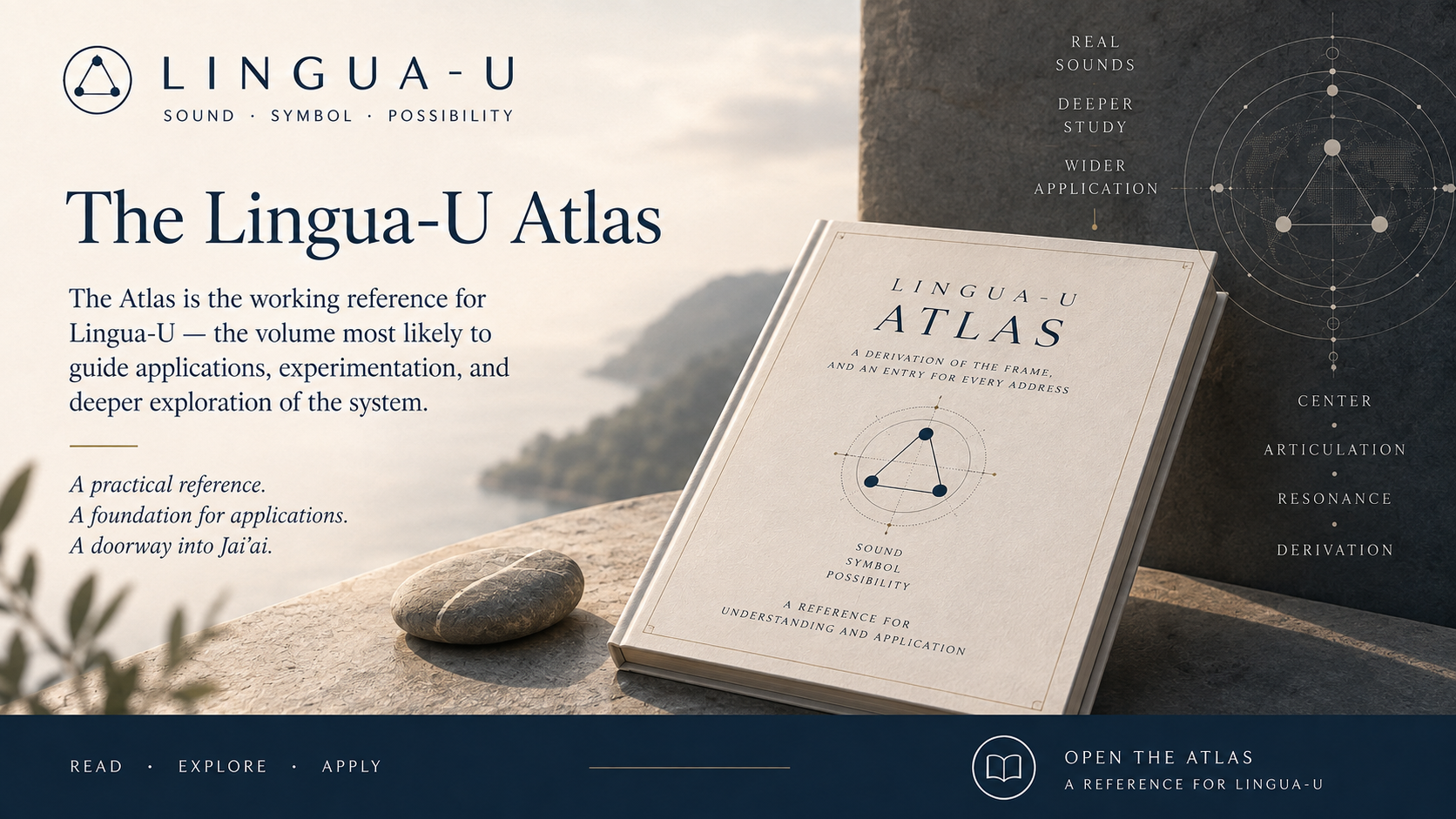
The Lingua-U Atlas is the working reference book of the Lingua-U system.
The Lingua-U Whitepaper explains the architecture and argues for the choices behind it. The Atlas does something different: it applies that architecture, deriving glosses from ternary sound addresses and providing an entry for every address in the system.
For that reason, the Atlas may ultimately prove even more important than the Whitepaper. The Whitepaper asks, Why is Lingua-U constructed this way? The Atlas asks, What can we do with it?
It is likely to become the main reference for practical applications of Lingua-U: poetry, contemplative practice, constructed language, symbolic analysis, visual art, and embodied work.
Foundational for Jai’ai
The Atlas is especially important for Jai’ai, the embodied expression of Lingua-U. Its glosses provide much of the semantic foundation from which Jai’ai can develop relationships among sound, symbol, movement, attention, and meaning.
But these glosses should not be treated as fixed mystical definitions. The Atlas explicitly describes them as consequences of the frame, not demonstrated meanings of the sounds. Whether practitioners actually experience stable resonances remains an open question.
That makes experimentation essential.
Explore the Sounds
Do not only read the Atlas. Make the sounds.
Repeat individual phonemes. Notice what happens in the lips, tongue, palate, throat, breath, and vocal folds. Compare neighboring sounds whose addresses differ by only one value. The Atlas itself uses simple bodily tests—such as touching the throat to distinguish voiced from voiceless sounds—to make these contrasts directly perceptible.
Stay with the sounds longer than ordinary speech requires. Then return to their glosses. Do the derived meanings illuminate anything you actually perceive? Do repeated experiments strengthen, weaken, or complicate the proposed associations?
The Atlas is provisional and invites readers to treat Lingua-U as an instrument to work with—and, where necessary, to break.
Use it as a reference, but also as a laboratory. Explore the phonemes deeply. Test the articulations in your own body. Invent applications. Record disagreements.
Lingua-U becomes most interesting when the Atlas stops being merely something you read and becomes something you can hear, speak, feel, and use.
Download
Get the Atlas: [The_Lingua-U_Atlas_V_1_0.pdf]