Try this before you read any further.
Take a breath, and on the way out, let your jaw fall open and sound a long ah. Not loud. Just enough that you can feel it. Let it run the length of the exhalation and then stop.
Now do it again with ee. Tongue up, forward, the sound narrow and bright.
Then oo. Lips rounding, the sound moving back and down into your chest.
That’s most of it. That’s the practice.
Why these three
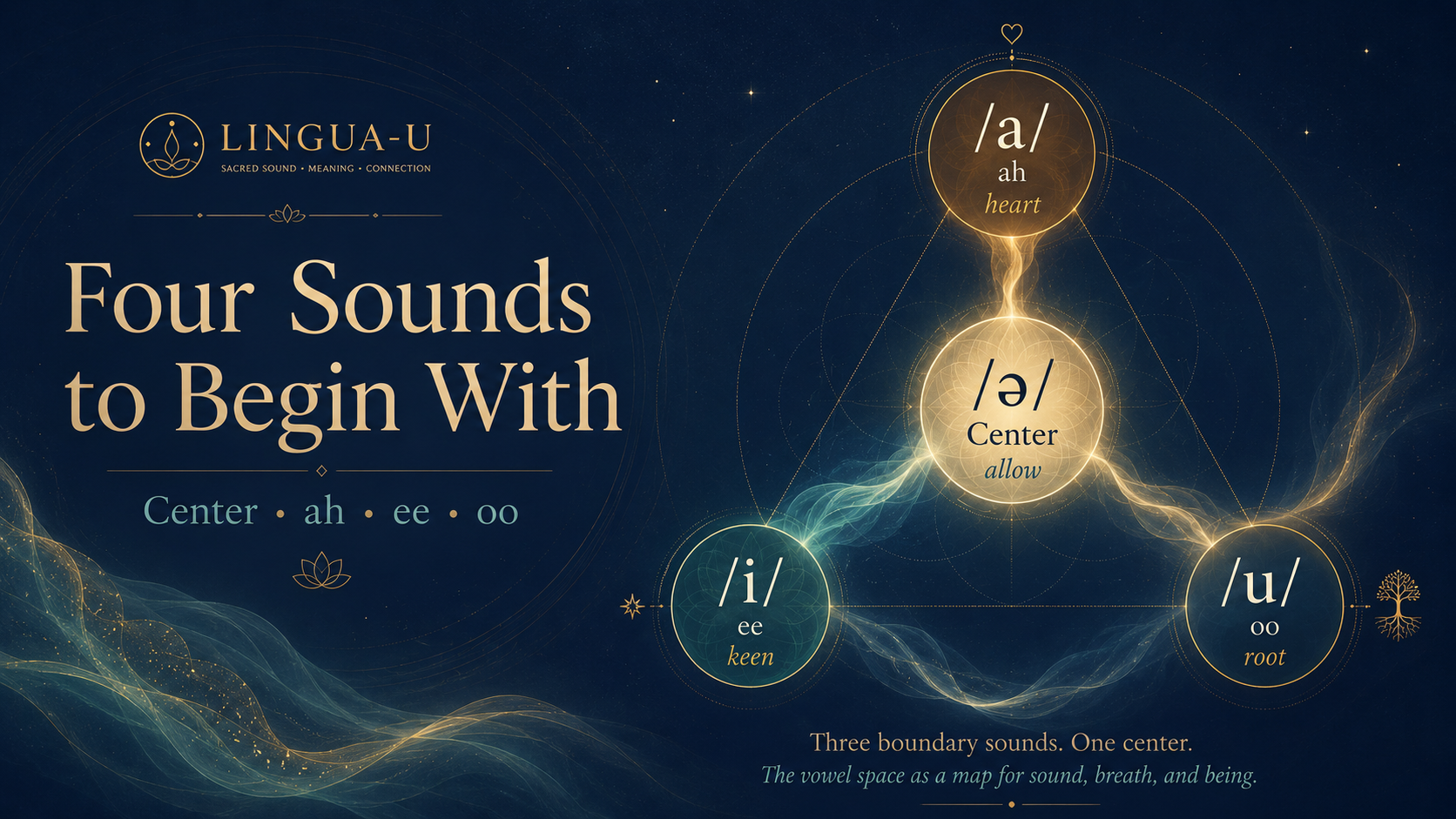
Something worth knowing about those three sounds: they are not three among many. They’re the far corners.
Ah is as open as your mouth gets. Ee is as high and forward as it gets. Oo is as high and far back as it gets. Every other vowel you can make lives somewhere in the space between them — they’re the boundary stones of the whole territory your voice can reach.
You can see this turn up all over the world. When a language has only a handful of vowels, these three are almost always among them. Unrelated languages, no contact between them, thousands of miles and thousands of years apart, arriving at the same three corners. Two-vowel languages barely exist. It seems the mouth simply has a shape, and this is it.
So when you sound them, you’re not doing something invented. You’re touching the outer edges of what human speech is made of. People have been standing at those three corners for as long as there have been people.
And a fourth
There’s one more, and it’s the strange one.
It’s the sound in the first syllable of about. Say it slowly: uh-bout. That first little unstressed vowel — barely there, easy to miss — is called the schwa. It’s the sound your mouth makes when it isn’t reaching for anything in particular. Tongue at rest. Jaw neither open nor closed. No commitment in any direction.
It’s what English vowels relax into when you stop working at them.
In this practice, we call it the Center — not because it’s mystical, but because it’s where you start from and where you come back to. Sound it between the others. Let it be the pause that isn’t quite silence.
Putting them together
The whole practice is those four sounds in a simple order.
You settle. You sound the Center. Then you open into ah, and come back to Center. Then ee, and back. Then oo, and back. Then you sit for a moment in the quiet afterward.
Five minutes. Once a day is plenty. You don’t need to be loud — many people find it works better soft, just enough voice to feel the sound in the body. You don’t need a special room, though somewhere you won’t feel self-conscious helps more than people expect.
There’s a second form that runs the three sounds together as one continuous movement rather than returning to Center between each. That comes later, once the sounds have become familiar on their own.
What they’ll come to mean
Each sound gets a word to hold alongside it. We suggest heart for ah, keen for ee, and root for oo, with the Center as allow.
Say them and you’ll notice something: each word contains its own sound. Heart opens on the ah. Keen is built around the ee. Root is oo with a beginning and an end. And allow starts on that quiet unstressed schwa, the Center sound, before it goes anywhere. The word and the vowel aren’t two things to remember. They’re one thing.
If a different set speaks to you more, try again · blossom · seed · fruit — the same four sounds, carried by growing things instead. Again opens on the schwa, blossom on the ah, seed holds the ee, and fruit the oo. It has a different feel: less anatomical, more patient, more agricultural. Some people take to one set and find the other slightly off, and there’s no more to that than temperament. Use whichever one you don’t have to work at.
Hold the word gently while you sound the vowel. That’s all the technique there is. You’re not trying to make anything happen, and you’re certainly not trying to feel something spreading through your chest because a document said you might.
Here’s the part we’d most want you to know at the start: those words are ours, and they’re on loan. As you practice, you’ll notice what these sounds actually do — in your body, in your attention, in whatever comes with them. At some point our word for one of them will stop fitting, and a better one will arrive. Yours.
When that happens, use yours. Write it down. That’s not you doing the practice wrong; that’s the practice doing what it’s for. A meaning you’ve found and kept will always carry more than a meaning you were handed.
The guide is on its way
We’re writing a proper guide — both forms in full, a short daily version, notes on what to do during the stretches when nothing much seems to be happening, and a simple way to keep track of the words you settle on as they change.
It’ll be here soon, and we’ll post when it’s ready.
In the meantime, you already have everything you need for today. Four sounds, one breath each.
Ah. Ee. Oo. And the quiet one in between.
Update: To learn exercises for putting Lingua-U into practice, see Introducing Introductory Exercises for Lingua-U Practice, v1.0