What might a sacred language of sound look like if we were designing one today?
Many spiritual traditions have treated speech as more than a vehicle for ordinary meaning. Mantra, sacred names, mystical alphabets, prayer, chant, and other forms of vocal practice all begin from the intuition that sound can participate in spiritual life—not merely by referring to something sacred, but through the act of sounding itself.
Lingua-U is a new, experimental approach to that territory.
It brings together contemporary phonetics, research into sound symbolism and phonosemantics, contemplative attention to the felt experience of speech, and a recursively ternary symbolic system. Its notation was inspired in part by the Taixuanjing, an ancient Chinese ternary system, although Lingua-U does not adopt its cosmology or claim to interpret it.
The project is deliberately constructive. Lingua-U does not claim to have discovered an ancient universal language hidden inside English. Instead, it asks whether we can build a coherent symbolic system from real features of human speech—and then explore what contemplative, psychological, and spiritual possibilities might emerge from that structure.
For readers familiar with Integral thought, one way of understanding the project is as an effort to keep several modes of inquiry in conversation: the objective study of articulation and acoustics, the subjective phenomenology of sounding, cultural traditions of sacred speech, and the constructive work of creating new symbolic forms.
Three documents now offer different ways into the project.
The Lingua-U Whitepaper
[Read the Lingua-U Whitepaper]
The Whitepaper is the best place to begin if you want to understand the architecture.
It describes how Lingua-U maps the vowels and consonants of General American English into a ternary address system based on phonetic categories such as manner and place of articulation and laryngeal state. It also explains the distinction between the formal system—which can be examined and tested—and the much more speculative symbolic meanings that might eventually be associated with it.
The Whitepaper is intentionally candid about what has not been established. Earlier versions of Lingua-U made stronger phonosemantic claims that did not survive testing; those claims have been withdrawn. The current system begins from a more modest premise: build the geometry first, test what can be tested, and resist turning structural elegance into metaphysical proof.
If you enjoy theory, linguistics, symbolic systems, or Integral-style attempts to bring multiple domains of knowledge together, start here.
An Invitation to Sacred Word Experiments in Lingua-U
[Read An Invitation to Sacred Word Experiments in Lingua-U]
The second document moves from theory into first-person investigation.
It invites curious readers—especially those already familiar with contemplative sound, chanting, prayer, or sacred-word practice—to explore individual phonemes directly.
What does a sustained /m/ actually feel like? How does /f/ change when it becomes /v/? Can you feel resonance shift as you move through /m/, /n/, and /ŋ/? What changes when a sound is encountered alone, in a neutral syllable, and finally inside a meaningful word?
These are experiments rather than teachings. You are encouraged to record what you actually experience before comparing it with anything Lingua-U proposes. Disagreement, ambiguity, or “nothing happened” are completely legitimate results.
The aim is not to prove the system but to cultivate unusually careful attention to speech and discover whether repeatable phenomenological patterns emerge.
Lingua-U Cardinal Sound Practice
[Explore the Lingua-U Cardinal Sound Practice]
The third document has a different purpose.
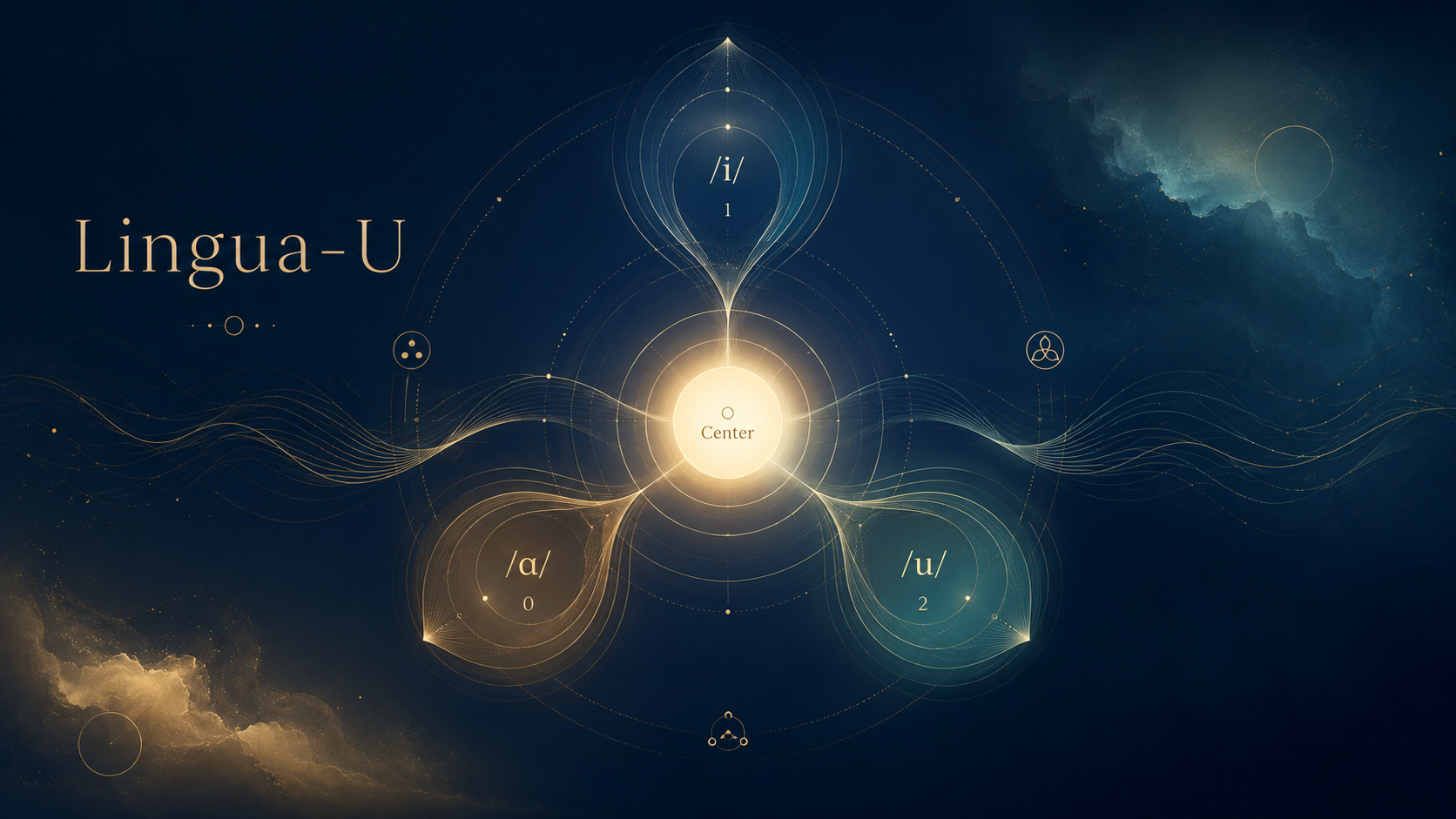
This is a simple meditation based on the Center and three cardinal vowels:
0 — /ɑ/ — expansion, release, emergence
1 — /i/ — refinement, focusing, differentiation
2 — /u/ — continuity, grounding, integration
with /ə/, the schwa, serving as the Center: availability and return.
Unlike the Sacred Word Experiments, this practice is not trying to eliminate suggestion. The association between sound and contemplative quality is cultivated intentionally. Through an Elemental Practice and a Cycle Practice, the practitioner gradually allows particular vocal gestures to become carriers and reminders of particular qualities of attention.
It is a new practice, not an inherited spiritual tradition, and its long-term effects remain to be discovered. But it offers a very simple way to begin experiencing Lingua-U rather than merely thinking about it.
Explore Freely
Lingua-U is still being built.
That makes this a particularly good time to participate. Read one document or all three. Try a five-minute sound practice. Question the phonetic architecture. Repeat a vowel and notice what happens. Bring your experience of mantra, Integral practice, linguistics, meditation, music, poetry, or spiritual traditions into the conversation.
Most of all, don’t feel obliged to agree.
If something works, I would like to know why. If something seems arbitrary, confusing, culturally tone-deaf, linguistically mistaken, spiritually fruitful, or unexpectedly beautiful, I would like to know that too.
Please share your observations in the comments below, or write to me directly at [EMAIL ADDRESS].
Lingua-U begins with a simple proposition: human speech is something we can study from the outside and experience from the inside.
What becomes possible when we do both at once?