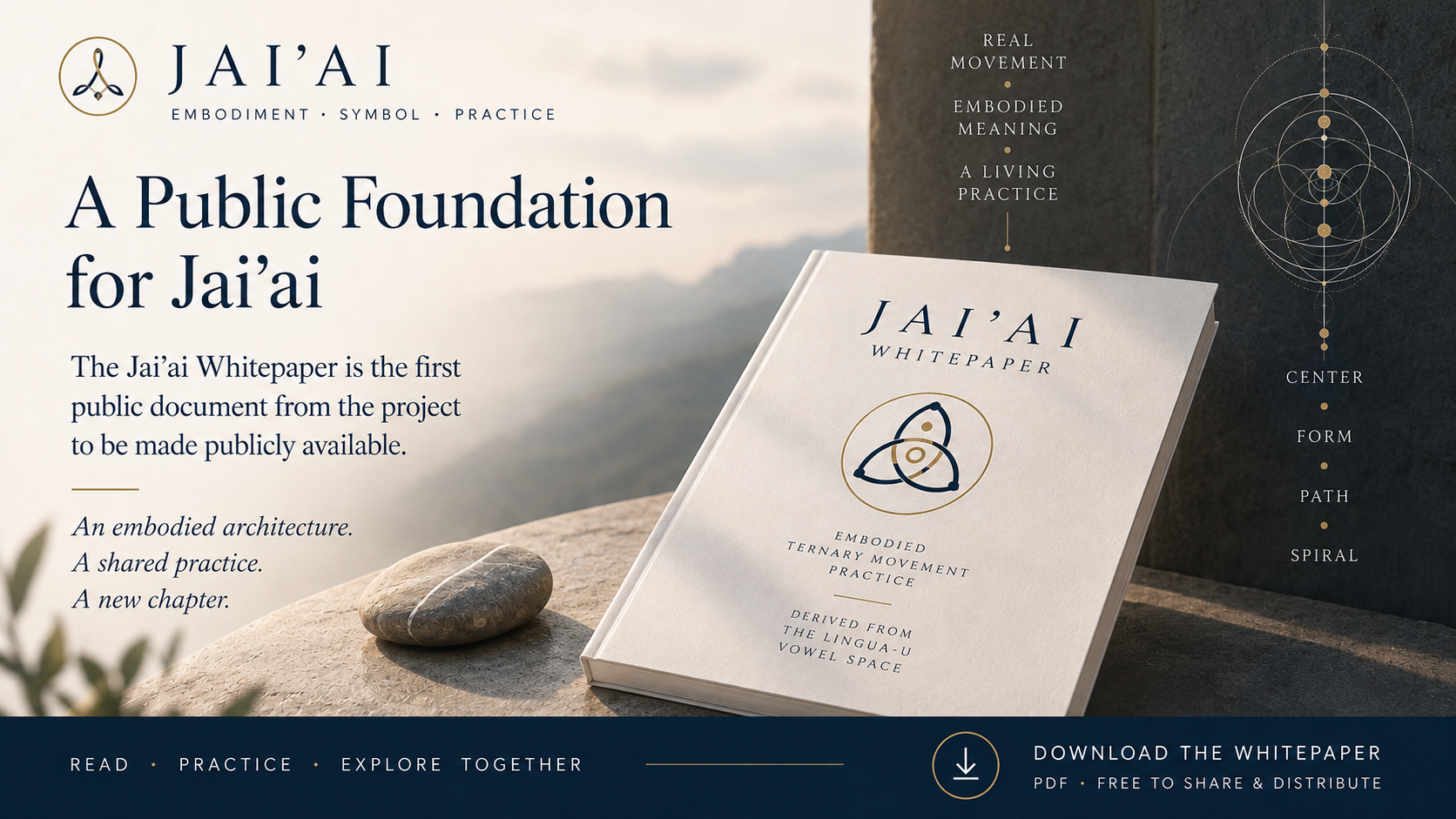
A practical foundation for embodying Lingua-U through the whole body.
The Jai’ai Whitepaper introduces the first working form of Jai’ai: an embodied practice derived from the vowel architecture of Lingua-U. It takes distinctions first expressed through the vocal tract and asks how they can be performed through posture, openness, weight, effort, and movement.
The aim is not simply to understand Lingua-U intellectually, but to begin learning its structures through the body.
What the Whitepaper Contains
Version 0.1 develops the vowel tier of Jai’ai in enough detail for direct practice. It introduces the Center, the three cardinal forms, and the nine addressed vowel forms, each derived from Lingua-U’s ternary vowel coordinates.
Lingua-U describes vowels partly through degrees of mouth openness and whether the tongue is centered, advanced, or withdrawn. Jai’ai translates these distinctions into the larger body: openness becomes the size of the bodily frame, while orientation becomes the forward, centered, or withdrawn placement of mass.
The Whitepaper also develops the relationship between tense and lax forms, paths between forms, spiral as a bodily analogue of lip rounding, and practical checks for determining whether the distinctions remain recognizable at different scales of movement.
Sound the Form
One of Jai’ai’s most distinctive practices is the simultaneous use of sound and movement.
A practitioner can hold or move through a bodily form while sounding the vowel that occupies the same Lingua-U coordinates. Mouth and body are therefore performing the same structural address through two different instruments.
This makes the Whitepaper an invitation to experiment with proprioceptive learning: hearing, sounding, and physically inhabiting distinctions that Lingua-U represents symbolically.
Begin with the Vowels
The Whitepaper deliberately starts small. It does not yet attempt to embody Lingua-U’s much larger consonant architecture. Instead, it concentrates on slow, solo practice without contact or partner work.
The forms can be practiced standing, at reduced amplitude, and in some cases seated. The emphasis is not on impressive poses, but on whether the underlying distinctions remain perceptible as the movement becomes smaller and subtler.
An Experimental Practice
Jai’ai is still in development. The Whitepaper does not present the forms as a finished tradition, martial art, therapeutic system, or established lineage. Its bodily mappings are proposals to be practiced, tested, and refined.
Practice the forms. Sound the vowels. Notice where distinctions are clear and where they blur. The Jai’ai Whitepaper provides the first map; the practice begins when that map enters the body.
Download
Get the docs: [The_Jai-ai_Whitepaper_v0_1.pdf]