Try this before reading any further. Put two fingers flat on the front of your throat and hold the sound /s/ for four seconds. Then, without stopping the airflow or moving your tongue at all, switch to /z/.
Under your fingers, a motor turns on.
Nothing else changed. Same tongue position, same channel of air, same place in the mouth. One thing changed — the vocal folds started vibrating — and in Lingua-U that single change is a single digit. /s/ is 1110. /z/ is 1111.
That is the entire argument for the document I’m publishing today, and I would rather you feel it than read it.
The problem with learning a system from a table
The Lingua-U whitepaper describes an address space in which every English sound is located by its articulatory commitments. Vowels get coordinates for aperture and orientation. Consonants get four digits — domain, sub-manner, place, laryngeal state.
A reader can follow all of that perfectly well without ever once checking it against their own mouth. And a system learned that way stays what it was on the page: a table to be consulted. You would know that Position III runs labial, coronal, dorsal without ever having felt your tongue make that journey from your lips to the back of your throat in the three beats of p, t, k.
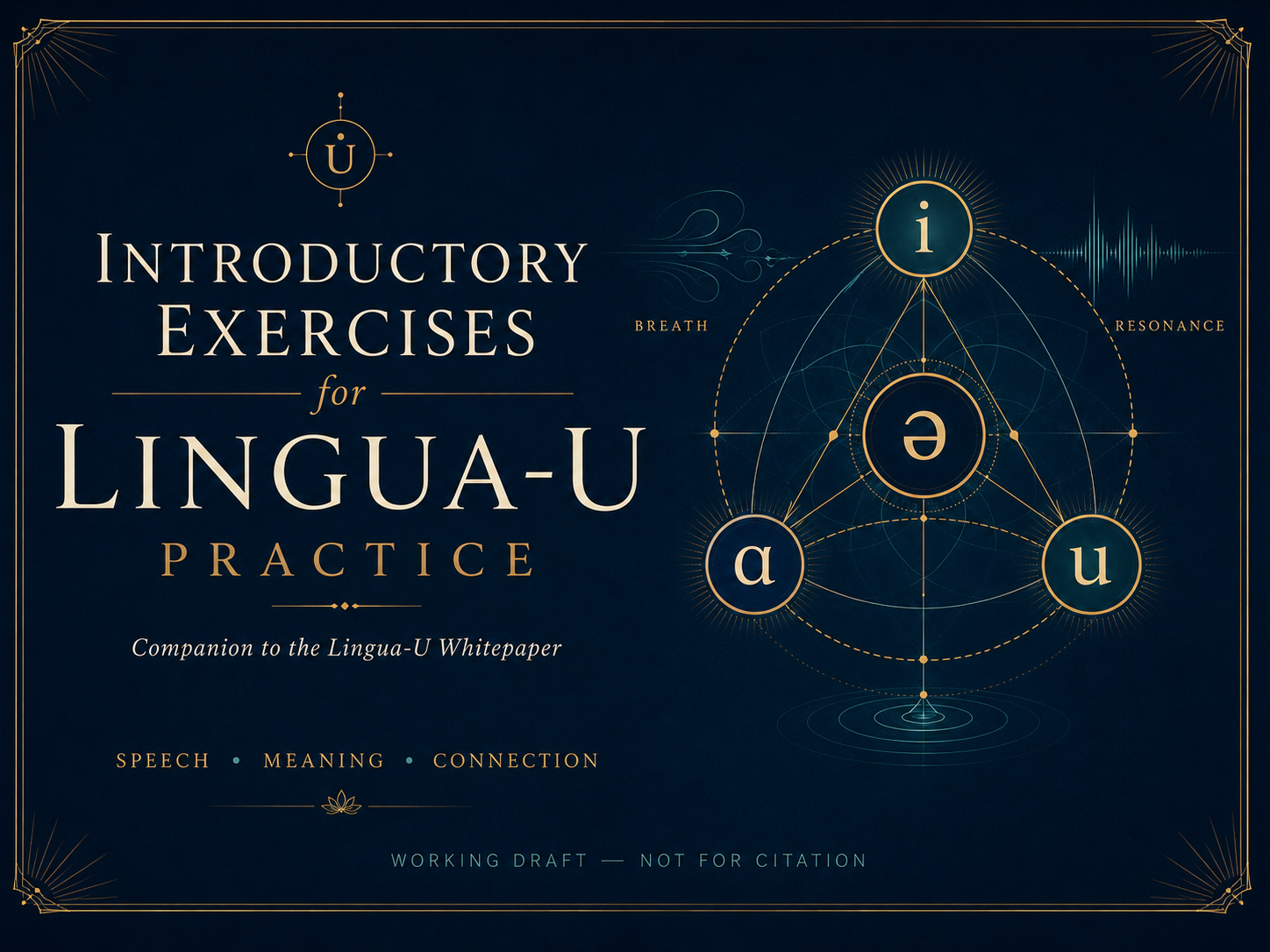
Introductory Exercises for Lingua-U Practice exists to close that gap. It is a set of numbered, do-them-out-loud exercises covering every vowel and every consonant of General American — organised so that what you end up knowing is not a table but a set of sensations that the table happens to describe.
What’s in it
Part I takes the ten vowels, including the schwa, which Lingua-U leaves deliberately unaddressed as the Center. You’ll spend some time noticing that the sides of your tongue press against your upper molars whenever you say /i/, which is almost certainly news.
Part II handles the twenty-four consonants — but not one at a time, which would be both tedious and misleading. The whole point of the four-position address is that the four decisions are separable. So the exercises are organised by axis rather than by segment: thirteen exercises, four axes, all twenty-four sounds.
A few of them reach past English entirely. Set your tongue for /l/, then blow: air escapes around the sides and hisses. That’s /ɬ/, the ll of Welsh Llanelli, sitting at address 1210 — a cell English doesn’t occupy but your mouth can reach in about two seconds. The whitepaper’s census of open cells stops being a spreadsheet at that point.
What it isn’t
It isn’t a contemplative practice, and nothing in it depends on the provisional symbolic layer. The honest analogy is scales. Preparatory, repeatable, worth doing before the material that assumes them.
It’s also explicitly a first tier. The exercises ask for attention rather than accuracy and assume no phonetic training. Later work will want more — sustained production, discrimination between sounds you don’t natively distinguish, movement through the address space at speed. As those are developed, they’ll be added and this document will be revised against them.
For now: version 1.0, twelve pages, and a strong recommendation that you read it somewhere you’re willing to make noise.
Download
Get the working paper: [Introductory_Exercises_for_Lingua-U_Practice_v1_0.pdf]